 By Hamza Taaouch · Updated · 21 min read
Etsy AI rules changed on 22 October 2026, and one change can affect a live listing today: every listing now needs at least one unedited photo of the real item. Two more changes can get listings removed, because Etsy now bans listings made by bots and patterns, recipes or instructions written by AI.
This guide shows what changed in the Etsy AI rules, what Etsy has confirmed, what is still unclear and the order in which to fix your shop. It is built on the Etsy Seller Handbook announcement, the Creativity Standards and independent coverage that tests the details, and it keeps confirmed facts apart from reports and my own advice.
The 30 second version:
- Bots: listings created by bots with no human involvement are banned.
- Guides: patterns, recipes and instructions made by AI are banned.
- Photos: every listing needs at least one unedited photo of the actual item on a real background.
- Disclosure: say so in the description when AI created the item, and never call it handmade.
- Next date: California SB 1050 starts on 1 January 2027.
Sellers of handmade goods, print on demand, digital downloads and patterns each get a dedicated Etsy AI rules section below, plus copy ready disclosure wording and a 7 step shop audit.
What are the new Etsy AI rules? The 7 changes at a glance
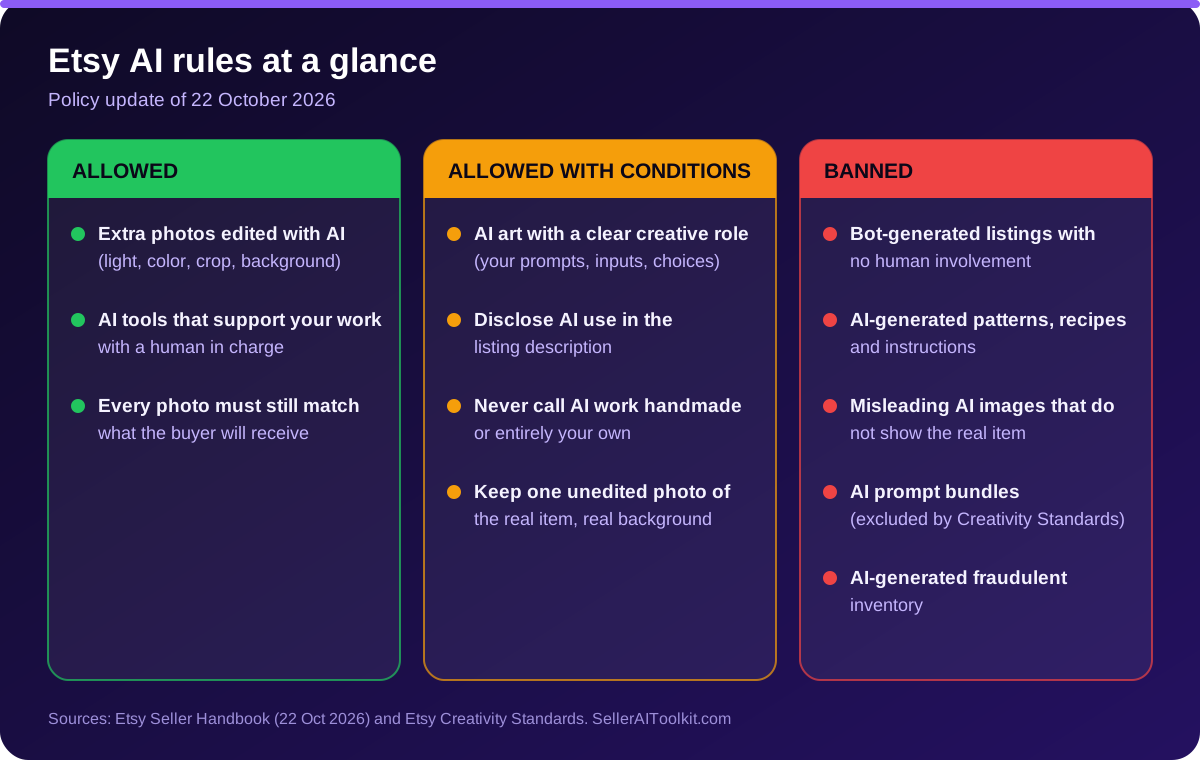
Short answer: the new Etsy AI rules are seven changes announced on 22 October 2026. They ban listings made by bots and patterns, recipes and instructions written by AI, require an unedited photo of the real item, and require disclosure when AI creates an item. Etsy says the goal is to protect buyer trust and calls the update a starting point.
| Change | What Etsy says | Who feels it most |
|---|---|---|
| Bot made listings banned | Listings with no human involvement will be removed and may lead to shop removal | Bulk listing and automation sellers |
| AI patterns, recipes and instructions banned | The information buyers rely on must be your own work | Pattern, recipe and plan sellers |
| Unedited photo required | At least one photo of the actual item on a real background, unedited | Almost every seller |
| Misleading AI images prohibited | Photos must accurately show what the buyer will receive | Sellers using AI scenes or mockups |
| AI disclosure required | Disclose AI creation and never present AI work as handmade | AI art and design sellers |
| Detection and buyer reports | Etsy is building detection tools and buyer reports begin as feedback only | Every seller over time |
| California SB 1050 | May require a clear disclosure for AI generated people in images, from 1 January 2027 | Sellers using AI models in photos |
The update to the Etsy AI rules sits on top of policy text many sellers already know. The Creativity Standards, last updated on 10 June 2025, already said AI creations can qualify under Designed by a seller when they come from your original prompts, and that AI prompt bundles do not qualify. What is new in the Etsy AI rules is the bot ban, the guide ban and the photo rule.
When do the Etsy AI rules start and how will Etsy enforce them?
Short answer: the Etsy AI rules apply now. Etsy says the updated policies and image requirements apply from 22 October 2026 and that sellers should review existing listings and update any that do not comply. Enforcement is expected to become more proactive over time.
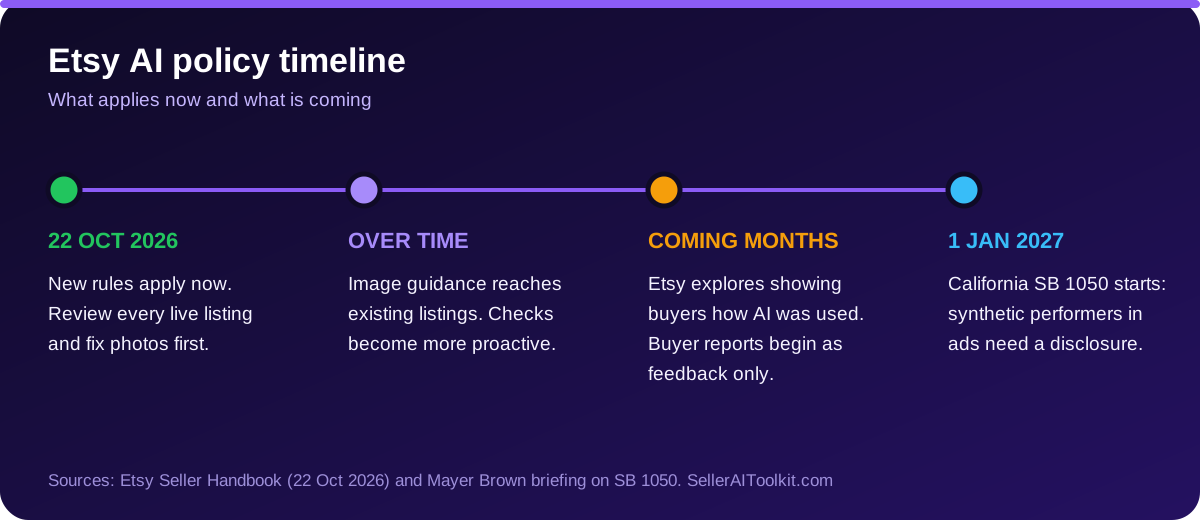
Etsy describes three layers of enforcement. First, when its system detects AI images while you create a listing, it shows tips to help you represent the item accurately. Second, Etsy is investing in tools that tell authentic images from misleading ones and find fraudulent inventory. Third, buyers get a new reason in the Report this item to Etsy flag, although these reports will not trigger immediate enforcement at first.
Existing listings carry a money risk even before detection reaches them. If a listing does not meet the image requirements and a buyer opens a case because the item is materially different, Etsy says you may need to refund that buyer. Digital Commerce 360 adds that detection will expand to existing listings over time.
Why Etsy changed its AI rules: buyer trust and AI shopping
Short answer: Etsy says AI content is eroding buyer trust, and it wants AI to support seller creativity instead of replacing it. At the same time, Etsy is building its own AI shopping features, so accurate listings matter more than before.
Digital Commerce 360 reports that Etsy is working with OpenAI, Google and Microsoft on agentic commerce, plans to sell directly through Google AI Mode and backs Google’s Agent Payments Protocol. It also reports that Etsy’s chief executive said in August that agentic AI experiences were under 1 percent of traffic, but that AI referred visitors show higher buyer intent and average order value than typical traffic.
Value Added Resource adds that Etsy lists the difficulty of telling which items involve AI among the top three barriers that keep buyers from shopping more often. That claim is reported, not confirmed on an Etsy page I could open.
My reading of the Etsy AI rules: a store that tells the truth in plain words is easier for a buyer and for an AI shopping assistant to trust. Clear titles, accurate photos and an honest description are the same assets that Etsy is now enforcing. That is an interpretation, not an Etsy statement.
Bot made listings are banned: what counts as a bot?
Short answer: Etsy bans listings created by bots with no human involvement. Etsy says these listings will be removed and can lead to shop removal. Etsy has not published a line that says how much human work is enough, so you need to be able to show that a person made the decisions.
Value Added Resource reports that Etsy expects each item to have individual human prompting, curation and oversight, and that it is unclear whether listing and cross listing tools are affected. Treat that as reported guidance, not a confirmed definition.
Here is a practical test I would use. You are on safe ground when a person does all five of these for every listing:
- You choose the product and its price.
- You write or edit the title, tags and description.
- You look at every photo and confirm that it shows the real item.
- You check shipping, materials and processing time.
- You press publish yourself after reading the final listing.
Under the Etsy AI rules, software that drafts text for you is not automatically a problem. Software that publishes dozens of listings that nobody read is the pattern Etsy describes. If you use a bulk tool, keep it to drafts and review each one before it goes live.
Patterns, recipes and instructions made by AI are banned
Short answer: Etsy bans functional guides created by AI, such as patterns, recipes and instructions, because buyers rely on the information working. The steps must be your own work, and the listing must show a real finished result made from your instructions, not an AI or simulated image.
This part of the Etsy AI rules hits craft, baking and plan sellers hardest. Value Added Resource reports that crochet and knitting patterns, recipes, woodworking plans and manuals fall in this group, and that Etsy pointed to flawed AI instructions that waste a buyer’s time and materials. Treat those examples as reported. The ban itself is written in Etsy’s handbook.
If you sell guides, this is the order I would follow:
- Pull any listing whose instructions you did not write and test yourself.
- Rewrite the steps from your own process, or make the item again while you take notes.
- Photograph the real finished result made from the instructions.
- Replace any AI render of the finished item in the photo set.
- Keep dated drafts and process photos for each guide.
One gray area remains in the Etsy AI rules. Etsy has not said whether using AI to proofread or translate your own text counts as an AI made guide. Until Etsy answers, keep your original steps as the source and limit AI to light edits that you review line by line. That is a precaution, not an Etsy rule.
The Etsy unedited photo requirement: what your listing needs
Short answer: each listing must include at least one photo of the actual item against a real background that has not been edited or changed. Etsy says exceptions apply depending on the item type. Every photo must show what the buyer will actually receive, with no hidden flaws or damage.
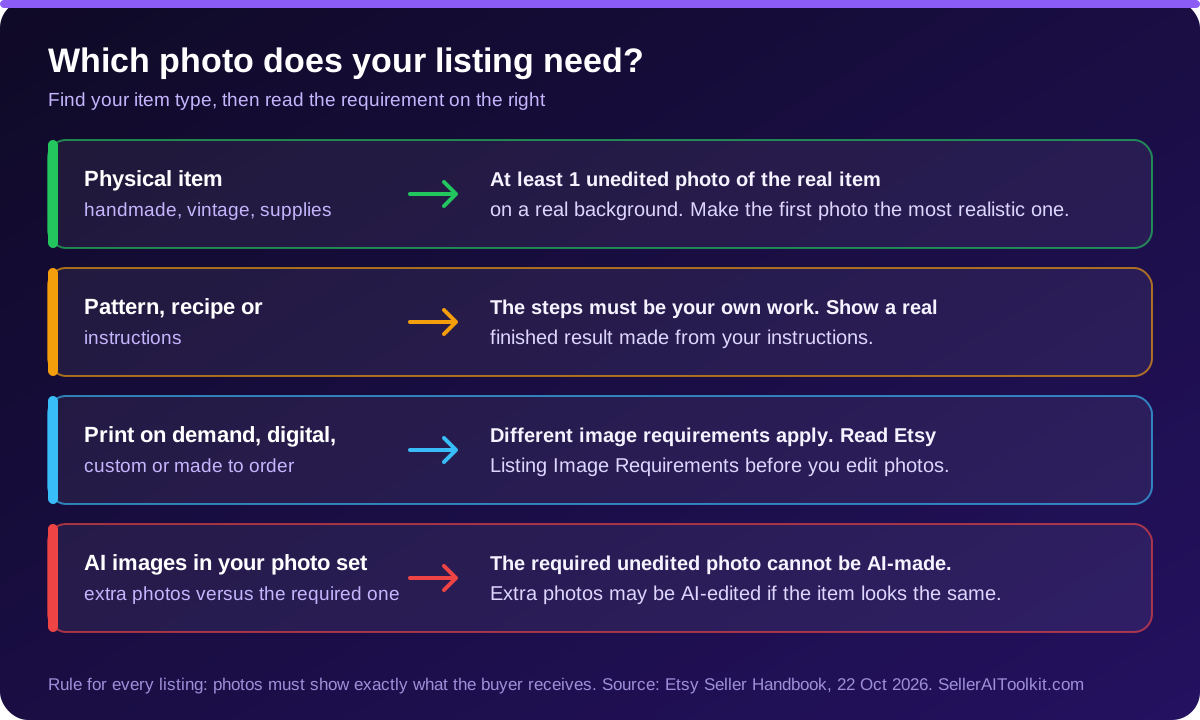
The Etsy AI rules allow editing on the other photos. Outside the required unedited photo, you may use editing tools, including AI, to adjust lighting or color, crop or resize, or change the background, as long as the item still looks the same. Etsy also recommends making the first photo the most realistic one, since buyers see it first, and noting AI photo edits in the description.
| Photo type | AI editing allowed? | Rule |
|---|---|---|
| Required photo of the real item | No edits | Real item, real background, unedited |
| Extra lifestyle photos | Yes, if the item looks the same | Lighting, color, crop, resize and background |
| Result photo of a pattern or recipe | Real finished result only | Made from your own instructions |
| Any photo that changes the item | No | Must match what the buyer receives |
Shoot the required photo like evidence. Value Added Resource notes that Etsy has not explained how detection separates banned AI images from automatic phone processing. So for the required shot, switch off beauty, portrait and AI enhance modes, keep the original file and avoid retouching. For size, Etsy’s image requirements page recommends at least 2000 x 2000 pixels, with the first photo at least 635 x 635 pixels, in JPG, GIF or PNG.
Etsy AI disclosure: what to write and where to put it
Short answer: yes, you must disclose AI use. The Creativity Standards say sellers must disclose within the listing description if an item is created with AI, and the new handbook adds that you may not present AI work as handmade or entirely your own. Etsy also recommends mentioning AI edited photos.
Write the disclosure in plain words near the top of the description, where buyers read it, and not in tags or a title. These templates are my wording, not official Etsy text, so adapt them to your listing:
| Situation | Copy ready disclosure |
|---|---|
| AI assisted artwork you directed | This design was created with AI from my own prompts and direction, then reviewed and finished by me. |
| Digital download with AI artwork | The artwork in this download was generated with AI based on my original prompts. You receive digital files only. |
| Extra photos edited with AI | Some extra photos use AI to adjust lighting or background. The first photo shows the real item, unedited. |
| Handmade item, AI used only for ideas | Made by hand by me. I used AI only to brainstorm the design. |
The last row is optional, since Etsy has not said that brainstorming counts as creation. It costs one sentence and removes doubt. Never describe AI work with words such as handmade or hand drawn unless that is literally true.
Is AI art still allowed on Etsy?
Short answer: yes, AI art is still allowed when you play a clear creative role and are open about the process. Etsy’s handbook gives the example of a fantasy scene based on your own prompt or inputs. What is not allowed is passing AI work off as handmade, or selling AI prompt bundles.
Etsy has not defined a clear creative role, so build one you can describe. These signals are my interpretation of the policy, not an official checklist:
- An original concept you can explain in two sentences.
- Several rounds of prompts and changes, not one click.
- A selection step where you rejected weaker versions.
- Hands on edits such as layout, color correction or typography.
- A finished product you checked, such as a print proof or a test download of the real file.
Digital artwork sits in the Designed by a seller group of the Creativity Standards, which allows designs created with AI based on your original prompts or inputs. Bundles or PDFs of someone else’s work do not qualify, and neither do AI prompt bundles.
Etsy AI rules for print on demand, digital downloads and custom orders
Short answer: the Etsy AI rules say different image requirements apply to print on demand, digital, customized and made to order items, but the announcement does not list the details. It sends sellers to its Listing Image Requirements policy, so read that page before you change any photos.
Some details have been reported by third parties. The table keeps what Etsy confirmed apart from what was reported, so you know how much weight each line deserves.
| Item type | Confirmed by Etsy | Reported by others, not confirmed | What I would do |
|---|---|---|---|
| Print on demand | Different image rules apply | Stock mockups from authorized partners can be used | Use partner mockups and keep a real sample photo if you own one |
| Digital downloads | Different image rules apply | Most need visual previews or excerpts | Show real pages or files from the actual download |
| Customized items | Different image rules apply | Show real examples of past work | Photograph a real finished custom order, with the buyer’s permission |
| Made to order | Different image rules apply | Show real examples of past work | Show your real work, not an AI render |
The reported column comes from Value Added Resource, whose article was updated on 24 October 2026. One more reported detail matters if you sell personalized items: the older rule against blank mockups with placeholder text as primary images was reportedly removed, yet the effect on personalized listings is described as unclear. Do not assume placeholder images are now safe. Check the image policy first.
Etsy AI rules by seller type: where your risk is highest
Short answer: under the Etsy AI rules, pattern, recipe and plan sellers face the highest risk, followed by bulk listing and print on demand sellers, while most handmade sellers mainly need to fix photos. Find your row in the table, then do the first action on your own shop today.
| Seller type | Main exposure | First action |
|---|---|---|
| Handmade physical goods | AI scenes that do not match the real item | Add an unedited photo of the real item and put it first |
| Jewelry and home decor | AI models or rooms showing a different item | Replace any scene where the item looks different |
| Print on demand | Mockups and bulk listing automation | Review each design and photo set by hand before publishing |
| Digital printables and wall art | AI artwork without disclosure | Add a disclosure line and show real file previews |
| Planners and templates | AI written text with no human editing | Rewrite and test the template yourself, then disclose AI help |
| Knitting, crochet and sewing patterns | AI written instructions and AI result images | Rewrite from your own work and photograph the real result |
| Recipes and baking products | AI recipes and AI food photos | Cook it, photograph it and keep your own notes |
| Custom and made to order | AI renders instead of real past work | Show real finished orders |
| Vintage and craft supplies | Edited photos that hide wear or change color | Show true color and flaws in the unedited photo |
What happens if you break the Etsy AI rules? Removal, refunds and appeals
Short answer: a listing that breaks the Etsy AI rules can be removed, bot made listings can lead to shop removal, and a buyer dispute over a materially different item can cost you a refund. If a listing is removed, you can appeal through the Policy violations page in Shop Manager, the same route used for other policy violations.
- Listing removal: Etsy says bot made listings and fraudulent AI inventory will be removed.
- Shop removal: Etsy says bot made listings may lead to shop removal.
- Refunds: a buyer case over a materially different item can require a refund.
- Buyer reports: a new report reason exists, but reports start as feedback and will not trigger immediate enforcement.
Etsy has not explained what evidence wins an appeal, and tools to prove authorship are reported as still in development. So build your own proof now. Keep one folder per listing with dated prompts, draft files, process photos and the original camera file of the required photo. This is a precaution I recommend, not an Etsy requirement, but it is cheap and it makes an appeal far easier to write.
California SB 1050 and Etsy listings: do you need an AI disclosure on photos?
Short answer: possibly, from 1 January 2027, if your listing images or videos prominently feature an AI generated person and buyers can be in California. Etsy’s handbook says SB 1050 may require a clear disclosure in that case and tells sellers to ask their own legal counsel. This is information, not legal advice.
According to a Mayer Brown briefing, the law was signed on 16 September 2026 and takes effect on 1 January 2027. A synthetic performer is a digital figure, voice or likeness made fully or partly with generative AI, and the duty applies when that performer plays a prominent role, for example demonstrating a product in the foreground, delivering the pitch or reacting to it. Background appearances may fall outside the law.
The briefing says the disclosure must be clear and conspicuous, with wording such as “this performance features a synthetic performer” or “no human performer is depicted”. It also says the law adds no separate civil penalty, but a violation may be treated as false advertising under California law, which allows private lawsuits.
Whether a single Etsy listing photo counts as an advertisement is a legal question that I cannot answer for you. The safest practical path is simple: use real models, show the product alone, or add a plain disclosure line to the description when an AI person appears. If you sell to California, ask a lawyer.
How to audit your Etsy shop for the new AI rules in 7 steps
Short answer: list every listing, check its first photo, fix photos and guides first, add disclosure, remove anything made by bots, then save proof. Start with your best sellers, because they have the most to lose. The steps below turn the Etsy AI rules into a plan you can follow in order.
Audit an Etsy shop for the October 2026 AI rules
Sort your listings by type
Open Shop Manager, list every listing and mark its type: physical item, print on demand, digital download, custom order or guide. Mark your best sellers first.
Check the first photo of each listing
Ask one question: is there at least one unedited photo of the real item on a real background? Mark every listing that fails.
Add or replace the required photo
Take a plain, honest photo of the real item, keep the original file and put it first. Keep AI edited photos as extra images.
Review guides, patterns and recipes
Pull any guide you did not write and test yourself. Rewrite it from your own process and show the real finished result.
Add AI disclosure where it applies
Put a plain sentence near the top of the description for any item or photo set created or edited with AI. Use the templates in this guide.
Remove or rewrite bot made listings
Unpublish anything that nobody reviewed by hand. Rewrite titles, descriptions and photos until a person stands behind every field.
Save proof and set a monthly check
Keep prompts, drafts, process photos and original camera files. Re read Etsy’s handbook each month, because the rules are still changing.
Common mistakes with the Etsy AI rules and how to avoid them
Short answer: the costliest mistakes are putting an AI scene first, retouching the required photo and publishing without a human review. Each one is easy to fix once you know Etsy treats it as a trust problem.
- Putting an AI scene first. Buyers see the first photo, and Etsy recommends that it be the most realistic one.
- Retouching the required photo. Unedited means no changes, so skip filters, straightening and background swaps on that one image.
- Hiding AI in the tags. The rule points to the listing description, so state it there.
- Calling AI work handmade. Etsy lists this as prohibited.
- Trusting a bulk tool to publish. No human involvement is exactly what Etsy bans.
- Keeping AI renders as guide results. A guide needs a real finished result.
- Waiting for a notice. Etsy says to review existing listings now, and a buyer refund case can arrive before any detection does.
What Etsy has not said yet about the Etsy AI rules
Short answer: Etsy has not published, in its AI rules, how much human involvement is enough, how detection works, or whether AI proofreading counts. Value Added Resource lists the same gaps, along with questions about third party tools and compliance timelines for existing listings.
- No threshold for how much human involvement counts as enough.
- No explanation of how detection separates banned AI content from allowed edits or automatic phone processing.
- No clear answer on whether third party listing and cross listing tools are affected.
- No details on appeal evidence or authorship tools.
- No clarity on placeholder style images for personalized items.
Plan for the strict reading of each gap. When a rule is unclear, choose the option that a buyer would call honest: show the real item, say when AI helped and keep the work human. This guide will be updated as Etsy publishes more detail.
How to use AI on Etsy without breaking the Etsy AI rules
Short answer: use AI to support your work and not to replace it. Etsy’s handbook says using AI to support your business is allowed as long as human creativity remains central. A simple way to stay safe is to sort every AI task into a green, amber or red zone.
If you use AI for your listing text, read our step by step guide to ChatGPT for Etsy listings, which shows how to write titles, tags and descriptions that follow Etsy’s April 2026 guidance and keep a person in charge of every listing.
| Zone | AI task | Why |
|---|---|---|
| Green | Brainstorming product ideas, drafting a description that you rewrite, planning a photo shoot | A person decides and writes the final listing |
| Amber | AI art that you direct and finish, AI edits to extra photos | Allowed with disclosure and a clear creative role |
| Red | Bot made listings, AI patterns, recipes or instructions, an AI image used as the required photo | Etsy bans these |
If you want prompts and workflows built around these limits, start on the Start Here page and look at the Shop page for new products. You can also read who writes this site on the About page.
Etsy AI rules FAQ: quick answers sellers ask most
Does Etsy allow products made with AI?
Yes, in some cases. Under the Etsy AI rules, Etsy allows AI creations when the seller plays a clear creative role, such as designing from original prompts, and when the seller discloses AI use in the listing. Bot made listings with no human involvement, and patterns, recipes or instructions written by AI, are banned.
Do I have to tell buyers that I used AI on Etsy?
You must disclose AI use in the listing description when an item is created with AI, and you cannot present AI work as handmade or as entirely your own. Etsy also recommends a short note when AI edited your listing photos, though it does not make that note mandatory.
Can I still edit my Etsy photos with AI?
Yes for extra photos, as long as the item looks the same after lighting, color, crop, resize or background changes. No for the required photo, which must show the actual item on a real background and stay unedited. All photos must match what the buyer receives.
Can I sell AI written crochet patterns, recipes or plans on Etsy?
No. Etsy bans functional guides created by AI, so the instructions must be your own work. The listing must also show a real finished result made from those instructions instead of an AI or simulated image.
Will Etsy remove my existing listings for breaking the new AI rules?
Under the Etsy AI rules, Etsy says the new policies apply now and that sellers should update listings that do not comply. It plans to extend detection to existing listings over time. A listing that fails can be removed, and a buyer case over a materially different item can lead to a refund.
How do I appeal an Etsy listing removal linked to AI?
Open the Policy violations page in Shop Manager and appeal from there, the same route used for other policy violations. Etsy has not said what evidence works best, so attach dated drafts, process photos and the original camera file of your required photo.
When does California SB 1050 start and does it affect me?
It takes effect on 1 January 2027. It may require a clear disclosure when an ad prominently features an AI generated synthetic performer shown to people in California. Etsy tells sellers to ask legal counsel, so check how the Etsy AI rules and the law apply if you use AI models in images.
How can buyers report AI listings on Etsy?
Etsy added a reason to the Report this item to Etsy flag for listings that may use misleading AI imagery. At first these reports help Etsy learn how buyers see AI, and they will not trigger immediate enforcement.
Etsy AI rules conclusion: what to do this week
Bottom line: the Etsy AI rules reward sellers who can show a person behind every listing. Bots and AI written guides are out, a real unedited photo is now standard, and honest disclosure protects you when AI helped. None of the Etsy AI rules bans AI. They ban using AI to pretend.
If you only have an hour, do these three things in order:
- Put an unedited photo of the real item first on your best selling listings.
- Rewrite or remove any pattern, recipe or instruction that you did not write and test yourself.
- Add a plain AI disclosure line to every listing that used AI, then start a proof folder.
Looking ahead, Etsy calls this update a starting point. It says image guidance will reach existing listings, that it will explore showing buyers how AI was used, and California SB 1050 arrives on 1 January 2027. Sellers who keep proof and honest disclosure now will have less to rebuild later.
This article is information for sellers, not legal advice, and Etsy can change its wording at any time. Check the official pages below before you make big changes to your shop.
Sources and further reading
- Etsy Seller Handbook: Important Updates to AI Use on Etsy (22 October 2026)
- Etsy Community announcement: Important updates to AI on Etsy
- Etsy Creativity Standards (updated 10 June 2025)
- Etsy help: Requirements and Best Practices for Images in Your Etsy Shop
- Digital Commerce 360: Etsy updates AI policy, noting concerns about buyer trust
- Mayer Brown: California joins New York in requiring disclosures in advertisements featuring synthetic performers
- Value Added Resource: Etsy bans AI generated patterns and tightens listing photo rules