 By Hamza Taaouch · Updated · 22 min read
Most advice on ChatGPT for Etsy listings tells you to fill all 140 characters of a title with keywords. Etsy’s own guidance changed in April 2026 and now says the opposite: keep titles short, avoid repeated words and write for a buyer, not for a computer.
This guide shows how to use ChatGPT, Claude or any AI assistant to write Etsy titles, tags and descriptions that follow that guidance and the October 2026 AI rules. It is built on the Etsy Seller Handbook and Help Center, it separates what Etsy has published from my own advice, and every prompt is written so that a person stays responsible for the final listing.
The 30 second version:
- Titles: name the item, put color, material and size first and aim for fewer than 15 words. The limit is still 140 characters, but you do not have to use it.
- Tags: use all 13, make them natural phrases of 20 characters or fewer and do not repeat phrases that already sit in your attributes.
- Attributes first: choose the category and attributes yourself, then ask AI to fill the gaps in your tags.
- Description: put the facts first, work keywords into the opening sentences naturally and never paste your title into it.
- Human in the loop: AI drafts, you check every fact against the real item. Etsy bans listings made by bots with no human involvement.
- Measure: change one thing at a time and judge it in Shop Stats after a few weeks.
How do you use ChatGPT for Etsy listings the right way?
Short answer: give the AI real facts about your item, ask it for options instead of one final answer, then edit and verify every line yourself. ChatGPT is good at wording, variety and structure. It does not know your product, your buyers or Etsy’s current rules unless you tell it.
That difference matters because an AI assistant will happily invent a detail. It may call a mug microwave safe, a necklace hypoallergenic or a print museum quality because those phrases appear in thousands of listings. A wrong claim in a listing can lead to a case, a refund or a bad review, so the facts must come from you.
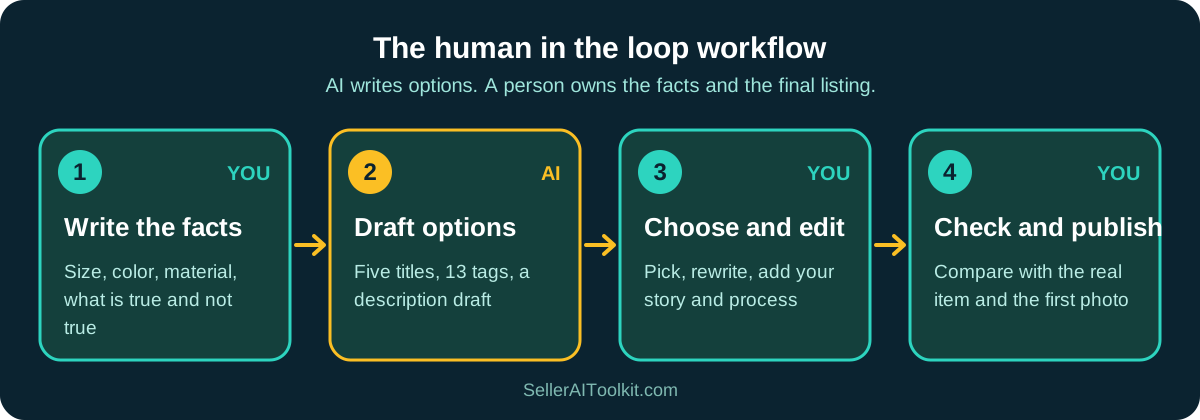
The safest workflow for ChatGPT for Etsy listings has four parts. You collect the facts, the AI drafts options, you choose and rewrite, and you check the result against the real item. The seven step routine later in this guide turns that into something you can repeat for every listing.
How does Etsy search read your listing in 2026?
Short answer: Etsy search works in two stages. First it matches a buyer’s query to listings using titles, tags, categories, attributes and descriptions. Then it ranks the matches using factors about the listing, the shop and the shopper.
According to the Etsy Seller Handbook article How Etsy Search Works, the system also looks at the first photo and at reviews. That is why a title is only one input. Etsy’s April 2026 title guidance repeats the point: titles still matter for search and for buyers, but they do not have to carry every keyword.
The ranking stage uses the factors in the table below, as Etsy describes them, and the last column shows what each one means for your prompts.
| Factor | What Etsy says | What it means for your AI prompts |
|---|---|---|
| Relevancy | How closely tags, titles, descriptions, categories and attributes match the query | Use the words a buyer would type, not decorative phrases |
| Listing quality | Several good photos and a return policy, plus shipping price for US domestic listings | AI text cannot fix weak photos or missing policies |
| Listing engagement | How well views turn into purchases | A clear title that matches the first photo converts better than a stuffed one |
| Customer service | Review rating, message response rate and case rate over the past three months | Do not let AI written claims create cases |
| Language | Listings should use the shop language, and seller written translations tend to do better than machine ones | Have a fluent speaker check any translated text |
| Recency | New or renewed listings get a short boost, and Etsy advises against renewing just for it | Do not regenerate and republish listings only for the boost |
| Shopper habits | Results are personalized to what buyers tend to purchase | Write for your real buyer, not a generic one |
Etsy also says that Etsy Plus does not change search placement, that Star Seller does not directly change ordering although it can help conversion as a trust signal, and that Etsy Ads affect placement only in designated ad spaces. None of that is something AI can change for you, so spend your prompt time on the parts you control: the words, the attributes and the facts.
What did Etsy change about listing titles in 2026?
Short answer: on 27 April 2026 Etsy published new title guidance that tells sellers to keep titles short and readable, ideally under 15 words, to name the item first, to avoid repeating words and to leave out price, shipping and sale details. The character limit is still 140, according to the Etsy Help Center.
The details come from the Seller Handbook article New Guidance for Listing Titles, and a Tool to Help. In plain terms, Etsy asks for the following:
- Name the item clearly and put its key traits near the start, usually color, material and size.
- Try not to repeat words, including repeated gifting phrases such as gift for him.
- Skip subjective words such as perfect or beautiful, which belong in the description or in tags.
- Leave price, shipping and sale information out of the title, because Etsy shows badges for those in search.
- Add a holiday or a recipient only when it is part of what the item is, for example a birthday candle.
Etsy also launched an optional AI powered title tool. It suggests revised titles from your current title, your first photo and your description, it works for English language listings only, and it lets you accept, edit, dismiss or write your own title. Etsy suggests downloading a CSV of your listings first so that you keep your original keywords for tags, descriptions and attributes.
Etsy adds that a suggestion does not mean your current title is underperforming, and that changes can take time to show results. That is a useful reminder before you rewrite every title in your shop in one afternoon.
How do you write Etsy titles with AI?
Short answer: give the AI your item facts and Etsy’s title rules, ask for five options under 15 words, then pick one and check it against your first photo. A good AI title names the item, leads with color, material and size, and reads like something a person would type.
Here is a simple formula that matches Etsy’s guidance: item name + key trait + material or color + size or use. It is a starting pattern that I recommend, not a rule from Etsy.
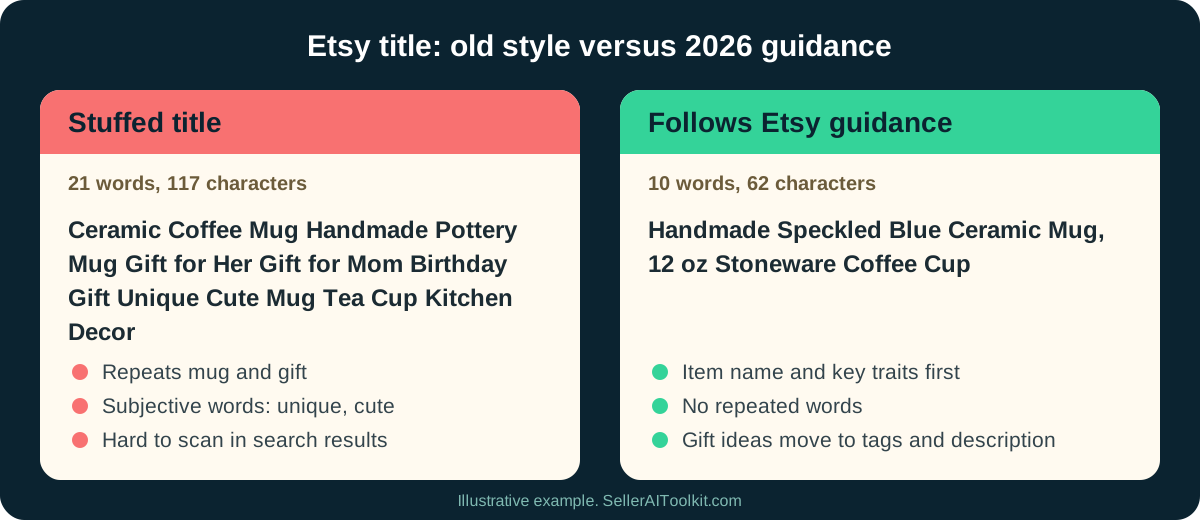
Take an illustrative example, a handmade ceramic mug. A title written for the old advice might look like the first row of the table. The second row follows the new guidance.
| Version | Title | Words | What to notice |
|---|---|---|---|
| Stuffed, old style | Ceramic Coffee Mug Handmade Pottery Mug Gift for Her Gift for Mom Birthday Gift Unique Cute Mug Tea Cup Kitchen Decor | 21 | Repeats mug and gift, adds subjective words and is hard to scan |
| Follows Etsy guidance | Handmade Speckled Blue Ceramic Mug, 12 oz Stoneware Coffee Cup | 10 | Names the item, leads with traits and repeats nothing |
The second title is much shorter, yet it still holds the main search terms: handmade, speckled, blue, ceramic mug, 12 oz, stoneware and coffee cup. The gift, kitchen and tea ideas move to tags, attributes and the description, where Etsy says they fit better.
Use this prompt to get options from an AI assistant. Replace the text in braces with your own facts.
You are helping me write an Etsy listing title.
Rules from Etsy: name the item clearly, put color, material and size near the start, use fewer than 15 words, repeat no words, leave out price, shipping and sale words, avoid words like perfect or beautiful, 140 characters maximum.
Item facts (use only these): {paste your facts here}
Task: write 5 title options. For each one show the word count and the character count. Do not add any fact that is not in my list.Always check the word and character counts yourself, because language models often miscount. Paste each option into a spreadsheet counter before you use it.
Then compare your favorite option with your first photo. Etsy says its search considers the first photo, and the title should describe what a buyer sees in it. If the title says speckled blue and the photo shows green, one of them is wrong.
How do you write 13 Etsy tags with AI?
Short answer: use all 13 tags, make each one a natural phrase of 20 characters or fewer, cover different search angles and do not repeat phrases that already sit in your title, category or attributes. Etsy’s tag guidance says tags may contain letters, numbers and spaces and that you get up to 13 per listing.
These rules come from the Help Center article How to Use Tags to Get Found in Search and from the Seller Handbook pieces Keywords 101 and The Anatomy of a Well Crafted Etsy Listing. Etsy advises multi word, natural phrases and says that if you cannot imagine someone typing a phrase into a search box, you should leave it out.
AI helps here because it is good at variety. A useful way to ask is by angle, so that the 13 tags do different jobs:
- What it is: blue ceramic mug, stoneware mug
- How it is made: handmade pottery mug, wheel thrown mug
- Who or when it is for: gift for tea lover, housewarming gift
- Size or use: 12 oz coffee cup, microwave safe mug
- Style or setting: rustic kitchen decor, artisan tea cup
Here is an illustrative set of 13 tags for the mug with the length of each. Every tag is at or under the 20 character limit. Use details such as wheel thrown or microwave safe only if they are true for your item.
| Tag | Characters | Angle |
|---|---|---|
| blue ceramic mug | 16 | What it is |
| speckled coffee mug | 19 | What it is |
| handmade pottery mug | 20 | How it is made |
| stoneware mug | 13 | What it is |
| 12 oz coffee cup | 16 | Size or use |
| housewarming gift | 17 | Occasion |
| gift for tea lover | 18 | Who it is for |
| wheel thrown mug | 16 | How it is made |
| microwave safe mug | 18 | Size or use |
| rustic kitchen decor | 20 | Style or setting |
| birthday gift mug | 17 | Occasion |
| coffee lover gift | 17 | Who it is for |
| artisan tea cup | 15 | Style or setting |
Use this prompt to generate a set like it. The last line asks for character counts, which you should still verify.
Write 13 Etsy tags for this item.
Rules: each tag 20 characters or fewer including spaces, natural multi word phrases a buyer would type, no repeated phrases, no copies of the title, category or attributes below, no misspellings, one language only.
Cover these angles: what it is, how it is made, who it is for, occasion, size or use, style.
Title: {your title}
Category: {your category}
Attributes already filled in: {your attributes}
Facts: {your facts}
Output a table with each tag and its character count.Etsy’s Keywords 101 lists tag mistakes you can screen for before you publish: repeating tags, using single words instead of phrases, leaving tags empty, deliberately misspelling keywords, mixing languages and using a label that is not true, such as calling something cashmere when it is not. It also says not to worry about plurals, because Etsy matches root words.
Why choose categories and attributes before asking AI for tags?
Short answer: because Etsy treats attributes like tags, and tags work best for ideas that no attribute covers. Etsy says that choosing a more specific category can unlock extra attributes, such as chain style for necklaces, and that you should pick the closest option even if it is not your exact wording.
Set these two fields yourself in the listing editor, then give the result to the AI. This stops the AI from spending your tag slots on a color or a material that an attribute already records. The Anatomy of a Well Crafted Etsy Listing article advises not to repeat a phrase as a tag when it already appears in your attributes.
The sequence I recommend for every new listing is: facts, photo, category, attributes, title, tags, description. That order is my own workflow and not an Etsy rule. It works because each step gives the next one better input, so the AI never has to guess.
How do you write an Etsy description with AI?
Short answer: put the essential facts first, work your main keywords into the first few sentences in a natural way, then cover materials, care, customization and the story of the item. Etsy says to keep the description short, informative and engaging, and not to copy your title or keyword list into it.
The Seller Handbook gives no fixed length. It asks for size, dimensions, colors or ordering directions first, then materials, care instructions, customization options and what makes the item unique, written in short paragraphs or bullet points.
A reliable description skeleton looks like this:
- Opening sentence: what the item is, who it suits and its main trait, with one or two key phrases written naturally.
- Key facts: size, dimensions, color, material and what is included, as a short bullet list.
- Details that decide the sale: care, use, limits and any customization options.
- Your story: how you make it, what inspired it and what makes your version different.
- Order notes: processing time, packaging and how to message you with questions.
- AI note, if needed: a plain sentence when AI created part of the item itself, as explained in our guide to the Etsy AI rules.
Write an Etsy listing description from the facts below.
Structure: opening sentence, key facts as bullets, details that matter, short maker story, order notes.
Style: plain, warm, first person, short paragraphs, no hype words such as perfect or luxurious, no claims that are not in the facts.
Do not copy the title. Work these phrases in naturally if they fit: {two or three phrases}
Facts: {your facts}
If a detail a buyer would need is missing, list it at the end as a question instead of inventing it.The last line of that prompt is the most important one. It turns the AI from a storyteller into a checklist, which protects you from invented details.
Then add what only you can supply: the real story, your process, your workspace, the size of your batches and how you handle a repair or a return. Those details are also what separates a real listing from a bot made one.
Does Etsy allow AI written titles, tags and descriptions?
Short answer: Etsy has not published a rule that bans using ChatGPT for Etsy listings or any other AI help with listing text, and it offers its own AI title tool. Its October 2026 rules ban listings created by bots with no human involvement and require disclosure when an item is created with AI. A person must stay responsible for every listing.
Etsy’s Help Center page on creating a listing says nothing about AI generated content. The rules announced on 22 October 2026 focus on bots, AI patterns, recipes and instructions, a photo of the real item and disclosure of AI created items. Our full guide to the Etsy AI rules covers each change and what Etsy has not clarified.
My reading, which is an interpretation and not Etsy’s wording, is that AI assisted copy that you review, correct and publish yourself sits on the safe side of the line, while bulk listings pushed live with no human check sit on the risky side. If you are unsure, keep the facts, the photo and the final edit in human hands, and keep your drafts and notes as proof of your process. Rules can change, so check the Etsy Seller Handbook before a bulk update.
How to write an Etsy listing with ChatGPT in 7 steps
Short answer: collect the facts, set the category and attributes, draft titles, draft tags, draft the description, verify against the real item, then publish and measure. The steps below follow that order.
Write an Etsy listing with ChatGPT or another AI assistant
Write down the real facts
Open a note and list size, color, material, weight, what is included, care, shipping time and anything that is not true for your item. Add the main details of your photos.
Choose category and attributes
Pick the most specific category you can, then fill in every attribute that fits. Copy the result into your notes.
Draft title options
Use the title prompt, ask for five options under 15 words and check the word and character counts yourself.
Draft 13 tags
Use the tag prompt, give it your title and attributes, and remove any tag that repeats them or runs past 20 characters.
Draft the description
Use the description prompt with your facts and two or three natural phrases, then add your own story and process.
Verify every claim
Read each line against the real item. Delete anything you cannot prove, such as safety, material or performance claims.
Publish, record and measure
Save the final text and the AI draft. Check Shop Stats after a few weeks and change one element at a time.
Which prompts catch mistakes before you publish?
Short answer: use the AI as a reviewer, not only as a writer. These three prompts check your finished text for unsupported claims, missing buyer information and repeated phrases.
Prompt 1: the strict fact checker. Run this on every listing before you publish.
Act as a strict listing reviewer.
Compare the listing text below with my facts. List every claim in the text that the facts do not support, every repeated word or phrase, and every promise about safety, health, durability or performance. Do not rewrite anything yet.
Facts: {your facts}
Listing text: {your title, tags and description}Prompt 2: the first time buyer. This finds the questions a buyer would still have.
Read this Etsy listing as a first time buyer who has never seen the item.
List ten questions you would still want answered before buying, such as size, care, shipping time and customization. Mark which ones the listing already answers and which it does not.
Listing: {your title and description}Prompt 3: the plain voice rewrite. This keeps the facts and removes hype.
Rewrite this Etsy description in the voice of a small maker: warm, plain, first person, short sentences.
Keep every fact exactly as written. Remove repeated phrases and these words: perfect, beautiful, amazing, luxurious, best. Do not add new claims.
Text: {your description}What should you check before publishing an AI assisted Etsy listing?
Short answer: check the facts, the counts, the repeats, the claims, the first photo and the policy. Use the table as a final gate, and fix any answer that is no before you publish.
| Check | Question to ask | Why it matters |
|---|---|---|
| Facts | Is every size, material and feature true for this exact item? | A wrong detail can cause a case or a refund |
| Title length | Is it under 15 words and 140 characters? | It matches Etsy’s April 2026 guidance |
| Title content | Is the item name first, with no price, shipping or sale words and no repeats? | Etsy shows badges for price and sales, and repeats add length without value |
| Tags | Do you have 13 tags of 20 characters or fewer with no copies of attributes? | Wasted tags are wasted search coverage |
| Attributes | Did you choose the category and attributes yourself? | Etsy treats attributes like tags |
| First photo | Does the title describe what the first photo shows? | Etsy search considers the first photo |
| Claims | Is there any health, safety or durability promise you cannot prove? | Unproven claims create cases and complaints |
| Description | Are the facts first, with no copied title and with your own story added? | Etsy asks for useful, natural writing |
| AI rules | Is a person responsible for the final listing, and is AI use disclosed where the rules require it? | Bot made listings are banned |
| Proof | Did you save your facts, drafts and final text? | It helps if you ever need to appeal |
What are the most common mistakes when using AI for Etsy listings?
Short answer: the most common mistakes are filling every character of the title, letting the AI invent facts, copying the title into the description, wasting tags on attribute words and republishing listings in bulk with no review. Each one is avoidable.
- Stuffing the title because the box allows 140 characters. Etsy now asks for short, scannable titles that name the item and its key traits.
- Trusting the AI counts. Models often miscount characters and words, so verify every count in a spreadsheet.
- Accepting invented facts. Anything not in your fact list should be deleted or confirmed.
- Reusing the same output for many listings. If ten listings share the same sentences, buyers see thin, repeated pages and the pattern moves toward the bot made listings Etsy bans.
- Mixing languages. Etsy says titles and tags should use the shop language, and that seller written translations tend to perform better than machine ones.
- Regenerating listings only for the recency boost. Etsy advises against renewing listings just to get that short boost.
- Ignoring the first photo. A perfect title cannot rescue a weak or confusing first image.
- Changing everything at once. You will not know which change helped.
Which AI tool should you use for Etsy listing text?
Short answer: use a general AI assistant for drafting, Etsy’s own title tool for a quick second opinion and a keyword research tool for demand clues. No tool replaces the facts only you have. Choose on workflow and price, not hype.
| Tool type | Good for | Limits |
|---|---|---|
| General AI assistant such as ChatGPT, Claude or Gemini | Drafting options, rewriting in your voice, checking for repeats and missing details | Can miscount characters, can invent facts and does not see live Etsy demand |
| Etsy’s AI title tool | Suggesting revised titles from your title, first photo and description | English language listings only, titles only, and a suggestion does not prove a problem |
| Third party keyword research tools | Search demand and competition clues for terms | Plans and prices change, and the data comes from the tool and not from Etsy |
| Etsy Shop Stats and search visibility dashboard | Seeing which listings get traffic and which need a refresh | Shows results, not the reasons behind them |
| Spreadsheet | Counting words and characters and tracking versions | Manual work |
I do not rank specific paid keyword tools here, because their features and prices change often and I have not tested them for this guide. Check the current plans on each tool’s own site before you pay.
How do you measure whether new Etsy titles and tags work?
Short answer: change one thing at a time, wait a few weeks and compare views, visits and orders for that listing in Shop Stats. Etsy says changes can take time to show results, so one day of data tells you very little.
Keywords 101 points to Shop Stats as the place to find listings with low traffic and refresh their tags with more varied terms. A simple routine looks like this:
- Pick five listings with steady traffic and note their current views, visits and orders.
- Change one element on each, for example the title on two listings and the tags on three.
- Keep a dated note of the old and the new text.
- Wait at least a few weeks, and longer in a slow season.
- Keep what improved the numbers, revert what did not and apply the lesson to similar listings.
Seasons, shipping price changes and new photos can all move the numbers, so treat the result as a clue and not as proof. Etsy also notes that engagement can drop after a shop goes on vacation mode.
What can AI not do for your Etsy listing?
Short answer: AI cannot photograph your item, prove your claims, earn reviews or guarantee a ranking. It can only help you present true facts clearly. The parts of a listing that Etsy says drive results are still yours.
- The first photo. Etsy says the first photo drives clicks from search results, that it should be at least 635 pixels wide and tall, and that all photos should ideally be 2000 pixels or more. Since the October 2026 rules, every listing also needs an unedited photo of the real item, as covered in our Etsy AI rules guide.
- Shipping and policies. Etsy says shipping price is a factor for US domestic listings, that buyers see expensive shipping as a top 10 barrier, and that clear shop policies help search placement.
- Reviews and service. Review rating, response rate and case rate over the past three months feed into ranking.
- Your expertise. The story, the process and the honest answer to a buyer question cannot be generated for you.
Etsy listing SEO with AI FAQ: quick answers sellers ask most
Can I use ChatGPT to write Etsy listings?
Yes, ChatGPT for Etsy listings works as a drafting tool. Etsy has not published a rule against AI help with listing text, but its October 2026 rules ban listings made by bots with no human involvement. Give the AI real facts, check every line and publish the listing yourself.
How long should an Etsy title be in 2026?
Etsy’s April 2026 guidance suggests fewer than 15 words. The limit is 140 characters, but you do not need to use all of it. Name the item first and put color, material and size near the start.
How many tags should I use on Etsy?
Use all 13 tags. Each tag can be up to 20 characters and may contain letters, numbers and spaces. Natural multi word phrases work better than single words, and you should not repeat phrases that already appear in your attributes.
Does Etsy have its own AI title tool?
Yes. Etsy launched an optional AI powered title tool that suggests revised titles from your current title, first photo and description. It works for English language listings, and you can accept, edit or dismiss each suggestion.
Do I need to disclose AI use in an Etsy listing description?
Etsy’s October 2026 rules require disclosure when an item is created with AI. Etsy has not published a separate rule about AI written listing text. Our Etsy AI rules guide has disclosure wording and lists what Etsy has not clarified.
Should I put keywords in my Etsy description?
Yes, naturally. Etsy says search uses descriptions as well as titles and tags, and it advises working relevant keywords into the first few sentences without repeating your title or tag list.
Will AI written tags rank my listing higher?
No tool can guarantee a ranking. Etsy ranks matching listings using relevancy, listing quality, engagement, service quality, recency and shopper habits. Good tags help matching, and the other factors still depend on your photos, shop and service.
Can I use the same AI text for similar listings?
Reuse the structure, not the sentences. Identical text across many listings looks thin to buyers and moves toward the bulk, no human involvement pattern that Etsy now bans.
Conclusion: use AI for wording and keep the facts human
Short answer: use ChatGPT for Etsy listings as a drafting and tidying tool for your titles, tags and descriptions, keep every fact and the final edit in your own hands, and follow Etsy’s April 2026 guidance of short, readable titles.
This week, pick three listings with the longest, most repetitive titles. Write the facts, set the category and attributes, run the title and tag prompts, check the counts and compare the new title with the first photo before you save. Note the date and the old text so you can measure the result in Shop Stats.
For the wider picture, open the Start Here page for the full set of guides, and keep the Etsy AI rules guide open while you edit, because it explains the disclosure and photo rules that sit around your listing text.
Sources and further reading
- Etsy Seller Handbook: How Etsy Search Works
- Etsy Seller Handbook: New Guidance for Listing Titles, and a Tool to Help
- Etsy Help Center: How to Use Tags to Get Found in Search
- Etsy Help Center: How to Create a Listing
- Etsy Seller Handbook: Keywords 101
- Etsy Seller Handbook: The Anatomy of a Well Crafted Etsy Listing
- Etsy Seller Handbook: AI policy update announcement
- Etsy Creativity Standards